

Board Director Program
Invalid liquid data
Invalid liquid data
Leading boards through transformative times
The Board Director Program from the Michigan Ross Executive Education at the University of Michigan empowers senior executives like you with the strategic insight and governance skills needed to excel in board roles across diverse industries. The program provides a deep understanding of the complexities of boardroom dynamics, corporate oversight, and values-driven leadership, preparing you to navigate the challenges and opportunities faced by corporate boardrooms.
This immersive five-month program is designed by thought leaders and experts from Ross Executive Education with backgrounds spanning corporate governance, strategic management, and board-level leadership. It offers a unique blend of online and on-campus learning, real-world case studies, interactive discussions led by world-renowned faculty and seasoned board members, and networking opportunities with global peers navigating similar responsibilities.
Upon completion of this program, you will emerge with the hands-on skills and credibility required to perform successfully on a board and add value at the highest level of an organization.
64%
63%
Source: PwC
Crafted to Advance Your Leadership at the Board Level
Live Online Sessions

Participate in engaging, live online sessions led by Ross Executive Education faculty, experiencing a real-time learning journey. Connect with expert faculty, industry leaders, and a diverse global cohort for discussions on governance, strategy, and leadership.
Five-Day Campus Immersion

Immerse yourself in a five-day in-person module on the University of Michigan campus in Ann Arbor, Michigan. Participate in thought-provoking discussions, hands-on sessions, and meaningful peer interactions designed to enrich your learning journey.
Knowledge in Practice

Learn through hands-on simulations and real-world case studies, applying strategic concepts to boardroom scenarios and sharpening your governance skills.
About the Ross School of Business
The Board Director Program leverages the academic excellence of Ross Executive Education, offering a unique opportunity to learn from world-renowned faculty and gain insights at the forefront of strategic leadership and corporate governance. Participants benefit from the expertise of a top-ranked business school with a global reputation for excellence.
#1
350,000+
Key program features

Comprehensive curriculum
Delve into best practices for effective board governance, including fiduciary responsibilities, ethics, and the navigation of complex organizational challenges.

Expert faculty
Learn from leading experts who are both thought leaders and experienced practitioners in their areas of discipline.

On-campus immersion
Immerse yourself in a five-day in-person module on the University of Michigan campus in Ann Arbor, Michigan, and benefit from a range of facilitated discussions, experiential sessions, and networking opportunities.

Real-world case studies
Engage in hands-on learning by analyzing real-world scenarios and case studies, applying theoretical knowledge to practical challenges.

Networking opportunities
Gain new perspectives and build lifelong connections by networking with high-achieving professionals from different industries.

Hands-on simulations
Engage in practical simulations that mirror real-world boardroom dynamics and complex decision-making scenarios to refine your strategic thinking and corporate governance skills.
Learning outcomes
The program will enable you to:
Understand Corporate Governance Principles – Develop a deep understanding of governance structures, fiduciary duties, and the roles of board members in ensuring organizational accountability
Enhance Strategic Leadership Skills – Learn to oversee corporate strategy, balance short-term performance with long-term growth, and navigate complex decision-making scenarios
Develop Financial Acumen – Gain proficiency in interpreting financial statements, evaluating key performance indicators, and assessing financial risks
Strengthen Risk Oversight Capabilities – Identify and mitigate operational, financial, and compliance risks while understanding the impact of emerging financial technologies
Leverage Digital Transformation and AI – Understand the role of emerging technologies, cybersecurity threats, and data privacy regulations in corporate strategy and governance
Foster Boardroom Effectiveness – Enhance communication, improve decision-making processes, and implement best practices for high-performing boards
Succession Planning – Learn how to build diverse board cultures, implement succession planning strategies, and foster inclusive leadership

Comprehensive curriculum
Corporate Governance Fundamentals
Roles and Responsibilities of Board Members: Learn about fiduciary duties, key legal legislation, and regulations governing board activities and the board’s role in overseeing management through performance evaluation, succession planning, and ensuring ethical conduct
Overview of Corporate Governance Structures and Best Practices: Explore topics such as board composition, key committee functions, and governance frameworks
Understanding the Relationship Between the Board, Management, and Shareholders: Dive into understanding board-management dynamics, effective shareholder engagement, and balancing the interests of stakeholders, including employees, customers, and the community
Learning Experience
Interactive case studies analyzing real-world governance successes and missteps
Guest lectures from seasoned board members sharing personal experiences
Strategic Leadership and Decision-Making
Developing and Overseeing Corporate Strategy: Learn about strategic planning frameworks like SWOT and PESTEL, the board’s role in overseeing the implementation of strategic initiatives, and fostering adaptability in response to market changes.
Balancing Short-Term Performance with Long-Term Value Creation: Explore strategies to assess performance using key metrics, engage stakeholders effectively, and develop strategies for sustainable and responsible growth
Evaluating Mergers, Acquisitions, and Other Significant Corporate Actions: Understand the board’s role in conducting due diligence, strategies for successful post-merger integration, and strategic decision-making for divestitures and spin-offs
Learning Experience
Simulation exercises on crisis management and strategic pivots
Workshops on fostering innovation and corporate agility
Financial Acumen and Risk Oversight
Interpreting Financial Statements and Key Performance Indicators: Learn how to analyze balance sheets, income statements, and cash flow statements as well as monitor key financial metrics to assess company performance
Understanding Audit Processes and Internal Controls: Examine the roles of external and internal audits, the importance of internal controls, and how they ensure financial integrity and regulatory compliance
Identifying and Managing Financial and Operational Risks: Identify, assess, and mitigate financial and operational risks through strategies like diversification, hedging, and contingency planning
Learning Experience
In-depth learning of emerging financial technologies and their implications
Panels with chief risk officers discussing contemporary risk landscapes
Ethical Governance and Corporate Responsibility
Establishing and Maintaining Ethical Standards and Corporate Culture: Learn how to develop a code of conduct, assess organizational culture, and understand leadership’s role in fostering ethical behavior
Navigating Conflicts of Interest and Ensuring Compliance: Identify conflicts of interest, implement mitigation strategies, and establish effective compliance programs to uphold legal and ethical standards
Integrating Environmental, Social, and Governance (ESG) Considerations: Explore ESG frameworks, stakeholder engagement strategies, and best practices for transparent ESG reporting and disclosure
Learning Experience
Scenario planning for ethical dilemmas and stakeholder conflicts
Sessions on global sustainability standards and reporting frameworks
Digital Transformation and Cybersecurity
Overseeing Digital Initiatives and Technology Investments: Learn how to align digital strategies with business goals, evaluate technology investments, and manage organizational change during digital transformation
Understanding Cybersecurity Threats and Data Privacy Regulations: Learn about cybersecurity risks, key data privacy regulations, including GDPR and CCPA, and best practices for incident response and compliance
Assessing the Impact of Artificial Intelligence and Emerging Technologies: Explore AI integration, the potential of emerging technologies like blockchain and IoT, and strategies for managing associated risks and ethical considerations
Learning Experience
Live demonstrations of cybersecurity breaches and defense mechanisms
Discussions on the ethical implications of AI in corporate decision-making
Integrating Governance Insights Into Strategic Decision-Making
Integrating Fiduciary Responsibilities into Strategic Decisions: Learn how boards apply duties of care, loyalty, and obedience to real-world decisions using high-stakes governance scenarios
Leveraging Regulatory Knowledge for Strategic Advantage: Understand regulatory frameworks, including SOX and Dodd-Frank, to enhance compliance oversight and strategic agility
Embedding Stakeholder Capitalism Principles in Strategy: Explore how boards integrate stakeholder perspectives into corporate strategy, drawing on real-world industry examples
Effective Oversight of Environmental, Social, and Governance (ESG) and Sustainability Initiatives: Strengthen board practices around ESG integration, long-term planning, and reputational risk
Navigating Short-Term Pressures Versus Long-Term Investments: Examine how boards manage short-term market demands while advancing strategies that deliver sustained business growth
Digital Transformation and Strategic Board Oversight: Explore the board’s role in overseeing digital transformation, cybersecurity, and innovation strategies
Effective Communication and Stakeholder Alignment: Develop effective approaches for communicating complex board decisions to diverse stakeholder groups
Learning Experience
Engage in real-world case scenarios and strategic exercises that simulate boardroom decision-making
Finalize a personalized action plan that integrates governance principles, regulatory knowledge, and stakeholder considerations into your board service
Immersive learning experience | On-campus sessions
The final module of this program is a five-day in-person experience on the University of Michigan campus in Ann Arbor, Michigan. During this immersive experience, you will participate in simulations and apply the strategic concepts learned during the program. This module will allow you to participate in engaging and interactive sessions on governance challenges and opportunities. Additionally, on-campus networking will provide opportunities to build lasting connections with industry leaders from around the globe.
Program calendar
Date | Time | |
|---|---|---|
Orientation session | March 25, 2027 | |
Live online session | April 22, 2027 | 11 a.m.-1 p.m. ET |
Live online session | May 5, 2027 | 11 a.m.-1 p.m. ET |
Live online session | May 20, 2027 | 11 a.m.-1 p.m. ET |
Live online session | June 10, 2027 | 11 a.m.-1 p.m. ET |
Live online session | July 9, 2027 | 11 a.m.-1 p.m. ET |
Live online session | August 19, 2027 | 11 a.m.-1 p.m. ET |
On-campus sessions | September 13-17, 2027 |
Note: Session dates and timings are subject to change.
Hear from past participants of the Board Director Program



Faculty
Mike Barger
Faculty Director, Board Director Program; Assistant Clinical Professor of Business Administration and former Executive Director, Ross Online, Stephen M. Ross School of Business, University of Michigan
Mike Barger leads courses in entrepreneurship, early-stage business development, and leadership during organizational crises at the Ross School of Business while facilitating ...

Brad Killaly, PhD
Clinical Associate Professor of Strategy, Michigan Ross, University of Michigan
Brad Killaly teaches strategy at Michigan Ross and previously led the full-time MBA program to its highest rankings in over two decades. His research explores strategic issues...

M. S. Krishnan, PhD
Accenture Professor of Computer Information Systems; Professor of Technology and Operations, Michigan Ross, University of Michigan
Dr. M. S. Krishnan teaches technology and operations at Michigan Ross and serves as the faculty director of the Business+Tech initiative and CK Prahalad and India initiatives....

Thomas P. Lyon, PhD
Dow Professor of Sustainable Science, Technology and Commerce; Professor of Business Economics and Public Policy, Michigan Ross, University of Michigan
Thomas P. Lyon is a leading authority on corporate environmental strategy, with joint appointments at the Ross School of Business and the School for Environment and Sustainabi...

Christopher Williams, PhD
Arthur Andersen Professor of Accounting; Area Chair of Accounting, Michigan Ross, University of Michigan
Christopher Williams is the Arthur Andersen Professor of accounting and serves as the area chair of accounting at Michigan Ross. His research focuses on the role of accounting...
Participant profile
The Board Director Program is suited for experienced executives across various industries and functions. It is particularly beneficial for:
Senior executives aspiring to serve on corporate or nonprofit boards and looking to drive long-term growth strategies
C-suite leaders and senior leaders seeking to transition to board roles, keen to understand best practices in corporate governance, and want to hone their strategic leadership and decision-making skills
Current board members looking to enhance their effectiveness by driving innovation and sustainability
Investors or advisors involved in board governance matters and are keen to stay ahead of changing global market trends and evolving regulatory landscapes
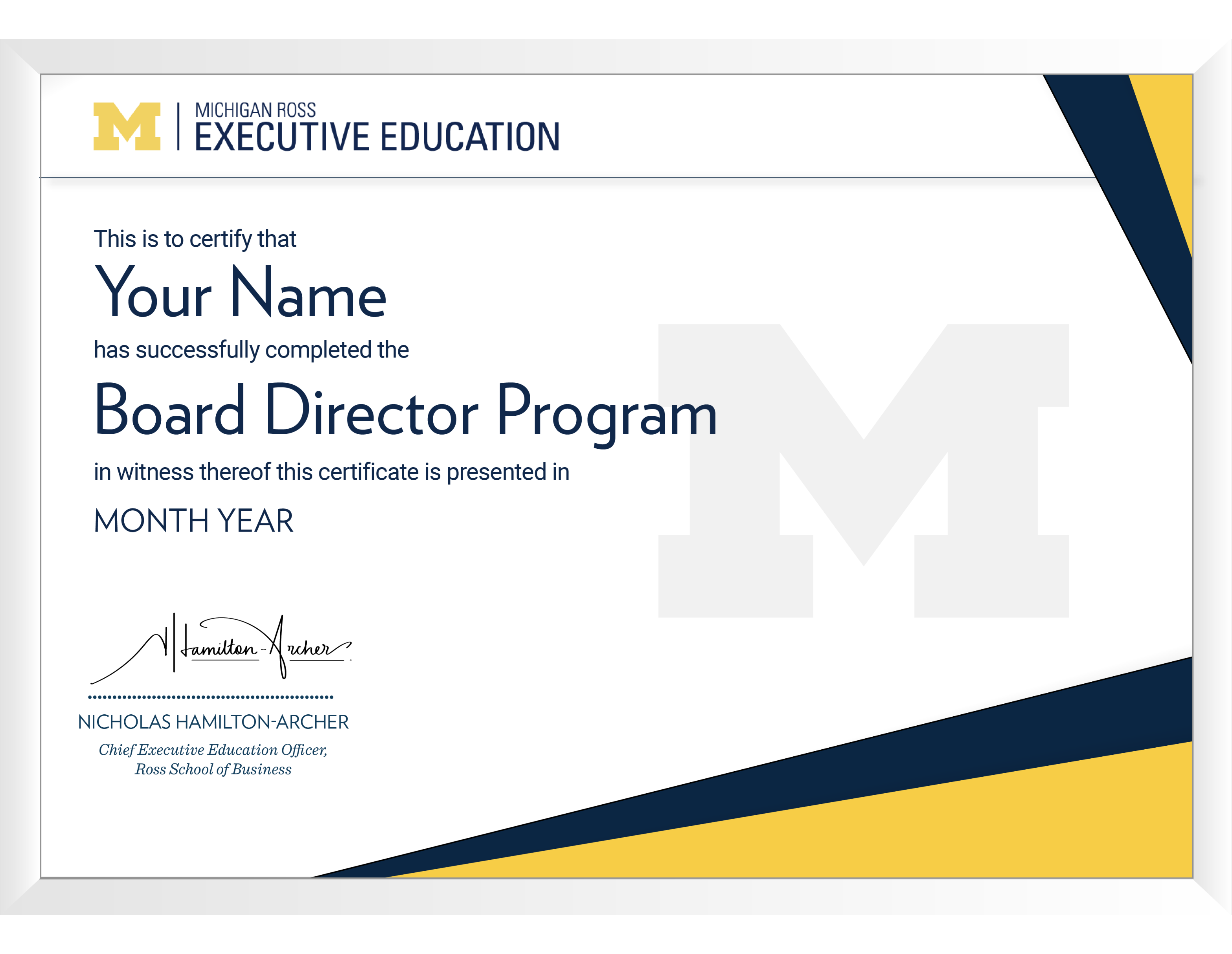
Certificate
Upon successful completion of the program, participants will be awarded a verified digital certificate by Michigan Ross Executive Education. The certificate will be a recognition of their achievement in the Board Director Program.
To meet the completion requirements for this program and receive a certificate, participants are expected to:
Attend at least five of six live online sessions
Fully participate in the on-campus component
Participants are expected to be present for the entirety of the on-campus residency. If they are unable to attend any part of the residency, we recommend delaying their application until a future cohort.
Note: After successful completion of the program, your verified digital certificate will be emailed to you in the name you used when registering for the program. All certificate images are for illustrative purposes only and may be subject to change at the discretion of Ross Executive Education.

Earn credentials
Upon successfully completing the program:
Receive a digital badge to showcase on LinkedIn and other social media platforms
Earn 8 credits toward the Distinguished Leader Certificate (DLC) which requires a total of 14 credits from qualifying in-person or online programs
Exclusive Program Fee Benefit for U-M Alumni
Graduates of the University of Michigan — including the Ann Arbor, Dearborn, or Flint campuses — are eligible for a 15% reduction on the program fee for the Michigan Ross Executive Education Emeritus partner programs.
Note: This alumni benefit cannot be combined with other promotional offers and is subject to change at the discretion of the university or school.
FAQs
Who will be collecting the payment for the program?
Emeritus collects all program payments, provides learner enrollment and program support, and manages learning platform services.
What is the program refund and deferral policy?
For the program refund and deferral policy, please click the link here.
Are there any restrictions on the types of funding that can be used to pay for the program?
Program fees for Emeritus programs with Michigan Ross Executive Education may not be paid for with (a) funds from the GI Bill, the Post-9/11 Educational Assistance Act of 2008, or similar types of military education funding benefits or (b) Title IV financial aid funds.
How does Emeritus support accessibility for learners?
Emeritus is committed to making high-quality education accessible and affordable to individuals, companies, and governments around the world. If you have questions about accessibility or would like to discuss available support options before enrolling, please contact accessibility@emeritus.org. For more information about our accessibility practices, please review our Accessibility Policy here.
Connect with a program advisor for a 1:1 session
Our program advisors have helped senior executives across the world choose the right program for their career goals. Schedule a 1:1 to get a deeper understanding on why the Board Director Program is the right fit for you.
Email: umib_bdp@emeritus.org
Phone: +971 80 0088601087 (U.A.E.) / +44 1377 310957 (U.K.) / +1 315 557 7286 (U.S.) / +52 55965 41726 (LATAM)
We encourage early application due to limited cohort capacity.
Flexible payment options available.
Starts On